


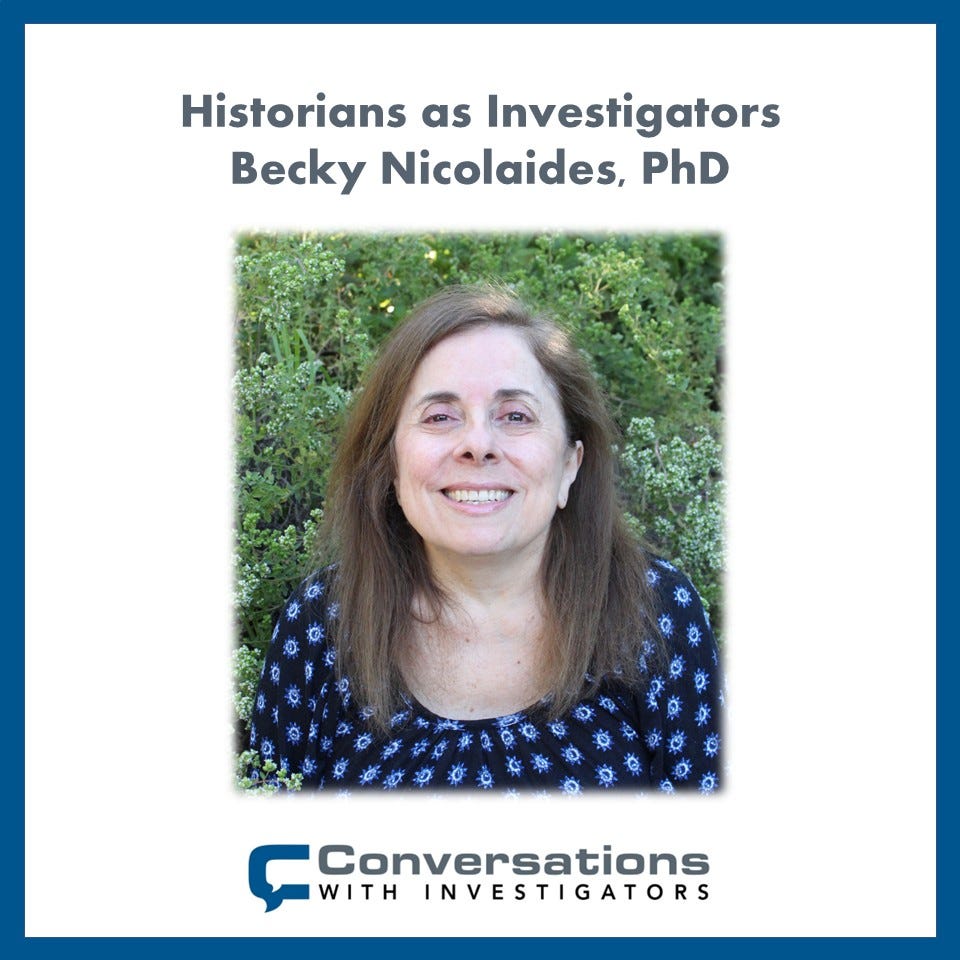
I have been a history nerd for years, so it probably isn’t a surprise that I ended up as an investigator. After all, historians are really investigators of the past. Both professions sift through incomplete evidence, interview witnesses, evaluate competing narratives, and try to reconstruct what happened. That was why I was excited to sit down with historian Becky Nicolaides, PhD to whom I was introduced by my friend and historian, Hal Barron.
Becky is the author of several award-winning books on the history of Los Angeles suburbs and has taught at UC San Diego, Arizona State University, UCLA, and Pitzer College. Becky co-founded History Studio to provide expert research, script vetting, and original content for the entertainment industry.
Keith: What attracted you to history?
Becky: I actually started college as a journalism major because I was curious about the world and fascinated by current events. Then I took a history course that completely changed my perspective. I realized that if you really want to understand why the world looks the way it does today, you must understand the past.
Keith: Historians are often pictured sitting alone in archives reading old documents. Your work is much more varied than that. Tell us about how you investigate the past.
Becky: I do spend a great deal of time digging through local newspapers, city records, historical societies, and library collections. Sometimes, the most valuable material isn’t neatly catalogued at all. It’s a messy file drawer in a local historical society or a box of ephemera that no one has looked through in years.
However, archives are only one piece of the puzzle so I also rely heavily on data. Census records are invaluable because they show how neighborhoods changed over time by many different measures. You really can’t understand a community without understanding its demographics.
Then there are oral histories, which I love capturing. I interview city planners, community leaders, and especially enjoy input from ordinary residents. They often provide the richest understanding of everyday life.
I rarely begin interviews with fixed conclusions in mind. Instead, themes begin emerging from the documents and the data, and I use interviews to better understand those themes.
For my recent book, I interviewed residents in Los Angeles suburbs including Pasadena, San Marino, South Gate, and Lakewood to understand what it felt like to live through enormous demographic changes. How did neighborhoods respond? How did those changes shape politics? Those are questions that statistics alone can’t answer.
Keith: How do you find people to interview decades after the events you’re studying?
Becky: Every project is different. For my dissertation, I met a librarian at the main LA Public Library downtown who had grown up in South Gate, and one introduction led to another. In San Marino, I noticed names appearing repeatedly in old newspaper articles, so I simply called people up and introduced myself. I’d explain that I was writing a book about the community and wanted to learn about their lives. Often, those conversations stretched over several interviews lasting two or three hours each.
In Lakewood, I worked through city officials and community organizations. During the George Floyd and #BLM protests, I attended community Zoom meetings and identified people whose experiences I wanted to understand more deeply.
There isn’t a formula. A lot of historical research is simply persistence.
Keith: That raises an ethical question. As investigators, we interview people knowing that their stories may become part of our reports. You face something similar as an oral historian.
Becky: I do.
After every interview, I provide a transcript they can review and change. I then ask the interviewee to sign a release permitting me to use the material. What I don’t do is let them edit my manuscript before publication.
That’s not always comfortable. I once interviewed a former politician who had been very active in anti-busing efforts. After the interview, he signed my release but later became nervous and wanted to review my book before it was published. I had to explain that he could read my book when it came out in the bookstores.
That situation made me think much more carefully about ethics. Several years later, I received formal training in oral history at UCLA, which broadened my thinking. Oral historians today often emphasize giving interview subjects more agency than historians have in the past where the narrator is really centered in the process. There’s even a concept called “rolling consent,” where they can change their mind at any point in the process. This is especially important when you’re interviewing people from groups whose stories have been mostly excluded or distorted.
Keith: I’ve often thought of investigators as historians of the present. Does that comparison resonate with you?
Becky: It does, although perhaps not exactly the way people might expect.
For instance, while researching San Marino, an upper-class suburb near Pasadena, I spent hours reading city council minutes looking for something when I unexpectantly discovered a series of measures enacted as wealthy Chinese families began moving into the community. Suddenly, there were strict architectural guidelines and one of the strongest English-only sign ordinances anywhere in LA county. Those decisions weren’t front-page news at the time, but together they told an important story about how the community was reacting to their new neighbors.
That’s one of the joys of historical research. Sometimes, the most revealing evidence is buried where no one has looked for decades.
Keith: We investigators spend a great deal of time talking about truth. Is there a truth out there?
Becky: That’s a difficult question. I don’t think historians possess absolute truth, and I don’t believe any single book should be considered the final word on a subject. I try to include as many voices as possible, especially people whose experiences often have been overlooked. If members of a community read my work and tell me, “Yes, that’s what it felt like,” then I feel I’ve captured something meaningful.
There is a humility that comes with being a historian. You’re always working with incomplete evidence, and you’re always aware that another document or another voice might deepen the story. I hope future historians revisit my work, challenge it, and improve upon it. That’s how scholarship advances.
Oddly, I find writing history easier than writing about the present. History feels finite. The events have already happened. The present is constantly shifting beneath our feet.
Let me turn the question around on you. Do you feel there is a truth?
Keith: I have spent a lot of time thinking about this. There is no short answer, but I believe there are truths. It is our job as investigators to look for that, even if we never find it. In fact, I’m giving a presentation in October with my friend, Allison West, entitled, “Is the Truth Out There? A Philosophical, Legal, Psychological, and Investigative Inquiry,” at the Association of Workplace Investigators Annual Conference in Seattle.
Earlier this year, your personal history was suddenly interrupted when you lost your Altadena home in the Eaton Fire.
Becky: Yes. We lost our home, along with my office and all of my physical research files. Fortunately, much of my work had been digitized and backed up in the cloud, but I still lost one-of-a-kind materials, including oral history interviews from earlier projects. It has been devastating and surreal.
One positive development is that I’m now helping prepare Altadena’s Historic Context Statement, which will help guide preservation and planning as the community rebuilds. It feels meaningful to contribute in that way.
Keith: What has given you the greatest satisfaction as a historian?
Becky: Without question, the people.
During COVID, I interviewed an African American couple in Lakewood who had spent decades working to make their neighborhood more welcoming and inclusive despite facing tremendous obstacles. Over time, I grew incredibly fond of them. At one point I worried I was losing my objectivity because I admired them so much.
What impressed me wasn’t simply their accomplishments. It was their generosity and humanity. After the book came out, we met in person for coffee. There were hugs, tears, and an overwhelming sense that this work had connected us in ways I never anticipated.
Those relationships remind me that history isn’t just about institutions or policies. It’s about people.
Keith: For readers who enjoy history, are there historians whose work you particularly recommend?
Becky: Heather Ann Thompson’s Blood in the Water about the Attica Prison Uprising is extraordinary investigative history. Kenneth Jackson’s Crabgrass Frontier transformed the study of suburbs. Eric Foner’s work on Reconstruction and concepts of freedom is essential, and Erica Armstrong Dunbar’s biography of George Washington’s slave who escaped, Ona Judge, is beautifully written. They’re all excellent historians and exceptional storytellers.
Keith: You and I have a shared passion for baseball. Your fandom took you to an unusual place. Tell us about it.
Becky: When I was a kid, I was completely obsessed with the Dodgers. I built a papier-mâché costume in the shape of an enormous baseball with a smiling face, called the Dodgers’ public relations office, and somehow convinced them to let me appear as a mascot on Opening Day in 1977.
Everything seemed to be going well until I wandered toward the bleachers and started getting pelted with popcorn. Eventually I made my way to the Dodgers’ dugout, handed Tommy Lasorda a bouquet of blue flowers, and was quietly escorted off the field.
It was probably the peak of my obsession with the Dodgers—and a wonderful memory.
Keith: Becky, thank you for a great Conversation. What struck me most was the humility that seems built into the historian’s craft. Like investigators, historians know they never have every piece of the puzzle. Perhaps that is why I have always seen the connection between historians and investigators.Subscribe for free to Conversations with Investigators.
What a great interview. As a fellow history nerd, I really appreciated the book recommendations.
A very interesting conversation. Thanx Keith